
Foundations of The Church:
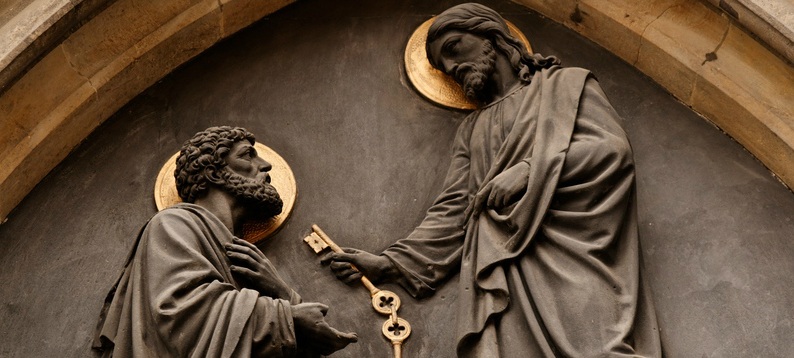 As a cradle Catholic, I often find myself wanting to learn more about the true beliefs of my faith. While I am not a theologian, as I visit with my protestant friends, I am often challenged by their questions in our discussions of faith. I would like to note that I love them all dearly and respect their positions. Therefore, I find myself researching more and more to uncover the truth of the faith that Jesus proclaimed. If I am wrong in my belief, I want to know so I may change, however, if I am right in my faith, I want them to know so they may have that same option. So, in my quest for truth, I want to take the time to understand their perspective while seeking to affirm what I know and believe to be true. This is what really inspired me to write this blog.
In one of my recent discussions with my friends, I found myself given a great opportunity of explaining "why" the Catholic Church believes it has the unifying authority it claims to possess. Although they had a number of objections to our beloved Catholic faith, after starting our discussions I realized most of their disagreements were because of a vast misunderstanding of exactly what we believe and why we believe it. For example, when a protestant sees a Catholic kneeling and praying before a statue of Mary, they believe we are participating in idolatry thinking we are worshiping and praying to the statue of Mary. When in fact, as a Catholic myself, I know we are simply asking our Mother Mary to pray with us and to intercede for us to her Son, Jesus. After all, Jesus has a hard time saying no to His Mother, wouldn't you agree? What better prayer group can you have, Mary, Joseph, and all the saints praying with you for an urgent need?
For this post, I would like to begin by exploring the basic foundation of the authority of the pope along with the visible unity of the Catholic Church as it existed over 2,000 years ago and still exists today.
As I began my research, I realized that the protestant churches took out the Eucharistic celebration, as the central part of their service, and replaced it with a long sermon that could extend for over an hour or two. Why I wonder? Exactly who or what are they actually worshiping during their service? I've heard many of my protestant brethren say "I have difficulty sitting in church, listening to an hour-long sermon and call that "worship." This gave me great pause and quickly got me thinking that what I am up against is much more than I initially realized. The journey has to start somewhere, so I wanted to bring it back to the very beginning when Jesus was first establishing His Church on Earth. For the first 1,000 years, there were no other religions, other than the Catholic Religion. Don't believe me? Go back and you read the Fathers of the Church. There were no Baptist, No Pentecostals, No Mormans, No Methodist, just no other faiths existed. Jesus establish ONE Church and yes, it was Catholic. You really discover this as you read the early fathers and discover what they believed and what they were teaching; Catholic Doctrine. We'll learn a little more of that a little later...
So, in these initial conversations with my protestant brothers, I also noticed a plethora of contradictory ideas and beliefs, within their own protestant organizations. On the surface, most of their core beliefs seem to be the same, however, as time went on I've found this not to be so. As an example; Some evangelicals believe in infant baptism while others don't. I began to realize these differences run even deeper and oftentimes within the same "faith-filled" communities. These various beliefs and interpretations simply exacerbate the issues and create even more divisions and confusion and do so even to this very day. I now understand why there are literally thousands of variations of faith with some saying over 30,000 various denominations exist with more starting every day.
Let Us Take A Closer Look
As one reads the Gospels, one quickly learns that Jesus wanted one church with visible unity. So, I asked my protestant friends; "If the Holy Spirit is guiding each of you as you read through scriptures, how is it even possible to be in such great conflict with each other's doctrine?" Is the Holy Spirit confused are is it you?
I also asked, "How do you, or your church, resolve these conflicts of understanding even within your own denominations?
Who is the authority you go to when you want to resolve conflicts and who grants them that authority? Where is that in the Bible?
It is no wonder that this creates so much division and results in either ignoring certain Biblical passages because they just don't fit the narrative or worse yet, creating even more new churches to try and explain the reason.
According to the Gospels, these fragmented churches are NOT what Jesus intended. In fact, man created these divisions, not God. Now, let us quickly contrast this to the Catholic Church which for over 2,000 years has maintained its' visible unity and still holds its authority. It is steadfast in its beliefs and is not swayed by modernism or public opinion. The Catholic Church does not seek to change its doctrine to "attract" more people to the faith nor will it change due to what people think it should be.
Next, let us look at the founders of each of these protestant churches and you will discover that men, who had different belief systems, started each and every one of them. Beginning with Martin Luther in 1517, who "protested" against the teachings and traditions of the Roman Catholic Church. Another example is John Smyth and Thomas Helwys who started the Baptist Church or William J Seymour and/or Charles F. Parham started Pentecostalism along with so many others who started their own church organizations; just too many to name here.
So what is one to do in order to see the true lineage and authority that Jesus wanted to establish? To find the truth, you have to start at the beginning by going all the way back to the early church fathers, wouldn't you agree? As we said earlier, if you read the early church fathers, even prior to the Bible being written, you will discover that for the first one thousand years there was one church and if you were a Christian, you belonged to that church; it was known as the Catholic Church. There was no disunity. (note: Catholic simply means universal) How do we know this to be true?
Let us first delve into what unifying authority did the early church have and why?
Who gave the Catholic Church this authority and where is that in the Bible?
Let us begin with Matthew 16:18-19 when Jesus asked, "who do you say I am?"
16 Simon Peter answered, ?You are the Messiah, the Son of the living God.?
17 Jesus replied, ?Blessed are you, Simon son of Jonah, for this was not revealed to you by flesh and blood, but by my Father in heaven. 18 And I tell you that you are Peter, [a] and on this rock, I will build my church, and the gates of Hades [b] will not overcome it. 19 I will give you the keys of the kingdom of heaven; whatever you bind on earth will be [c] bound in heaven, and whatever you loose on earth will be [d] loosed in heaven.?
Footnotes
a) Matthew 16:18 The Greek word for rock is Petros or Petra for Peter*(see more below).
b) Matthew 16:18 That is, the realm of the dead
c) Matthew 16:19 Or will have been
d) Matthew 16:19 Or will have been
??????
*In the Greek translation, rock, is Petra and is in its masculine form and Petros is the feminine form. In Aramaic, which is the language Jesus actually spoke, it is "Kepha" which translates "rock" and has no masculine or feminine form so there really is no ambiguity in Aramaic.
Now, my protestant brothers and sisters will try and explain this away, because to accept Peter as the leader of the apostles and head of the church puts them in a precarious situation. They would then have to accept Peter as our first pope and follow the unbroken lineage of the popes (or successors) all the way up to this very day. Some protestants will proclaim an apostasy occurred, yet this just didn't happen. The historical lineage of popes creates an obvious and clear trail of succession. A deeper dive will make it even more clear beyond any of these types of arguments. So, let's continue...
One of the most common protestant responses that are often put forth is the name, Peter. The argument is that it doesn?t refer to a big rock that is used as a foundation stone for Jesus? Church. Instead, they say it means a little rock that is used more as Peter's faith.
So let's take a look a this... First of all, Jesus spoke in Aramaic, and in Aramaic, the word Kepha offers no distinction between big and little rocks. We also know this to be the original name Jesus gave to Peter because both John and Paul use it to refer to Peter. (Read John 1:42 and 1 Cor. 15:5) In addition, on what grounds can we separate the person of Peter from his faith? Peter (Kepha), is named as the rock on which Jesus would build his Church because of Peter's faith, which is an integral part of Peter himself. At this point, there is no mistake in what Jesus really meant... now let's continue to further discover why this is true.
DIVING EVEN DEEPER
Now, let's all journey to Palestine and arrive at the exact setting Jesus used to convey this all-important proclamation. As we travel north of Galilee and proceed all the way to Caesarea Phillippi we come to the location where Jesus actually proclaimed Peter as the head of the church in Matth 16:18-19. This area is now known as Banyas, which originated from the Greek god "Pan" (this old greek god was known as the god that ruled over nature and pasturelands) Since locals did not have the "P" sound in their dialect the pronunciation was with a "B" sound and therefore has evolved to "Banyas.")
The question is; "Why did Jesus travel two-hard days through the mountains and rough terrain with dangerous wild animals everywhere? Knowing that everything Jesus did had a real purpose we must look at what was going on during that time. This important announcement that Jesus was getting ready to declare is thereby very significant and Jesus chose this unique environment for a number of reasons. (Note: Jesus had a purpose for everywhere He went, everything He said, and everything He did; so, it is no accident He was willing to travel two hard days through incredibly rough terrain to be at this location and make this proclamation)
In Caesarea Philippi, there exists a gigantic rock, over 500 feet long and 200 feet high and in the back, center-left, there is a huge cave that had a deep 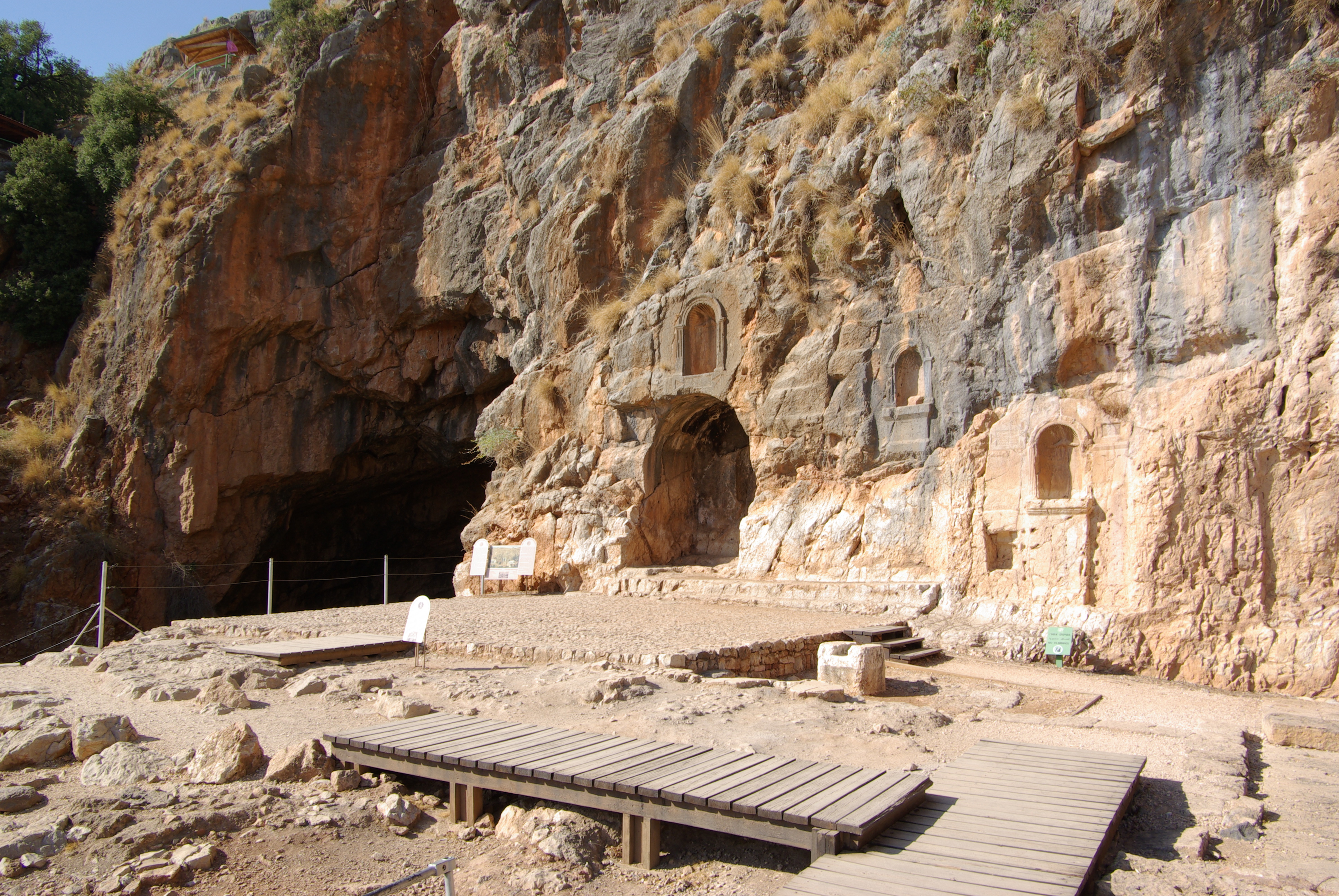 bottomless pit in it. There was water in this pit and since the residents could never find the bottom, even after lowering ropes down into it they felt it went all the way down to the netherworld. The spring that existed in this pit was actually feeding the Jordon river which is the main water supply or lifeline for the entire area. Sacrifices to the gods were made by throwing these sacrifices into this pit, referred to as the "jaws of death." This area became the center of pagan worship because of these features.
Now, on this huge rock, interestingly enough, there existed a temple built by King Herod for "worshiping" Caesar Augustus who was revered as a god himself, along with a number of pagan gods of that time surrounding it. (note: King Herod built this temple seeking favor from Caesar)
So, Jesus came to this location, in particular, to proclaim that this was a "false rock", with a "false temple" built upon it, honoring all of the "false gods" that surrounded it and Jesus declared it was to be no more. Jesus, turning to Peter and all the disciples, was really saying that we are going to be doing something new and different now. And what Jesus was really saying, you, Peter (Kepha in Aramaic meaning "rock") you are the true rock and on this new rock I (Jesus) will build my church and the gates of hell (as he pointed to the cave and bottomless pit) will not prevail against it. In fact, if you really reflect upon this event, the Church is being built on Peter, and the water that comes forth from the church that Jesus is now establishing will water God's people, it will sustain them, and the gates of hell will never prevail against it.
As a side note; as the pagans threw sacrifices into the cave or pit they would look to see if the blood came out in the stream below. If it did, that meant their god, or gods, had rejected their sacrifice. The opposite is true in Christianity. When the sacrifice of Jesus was made and Jesus' blood is shed and flowed on the cross, God accepted Jesus' sacrifice. (Note: In those days, the blood correlates with "life.")
By actually being there, the apostles knew full well the impact of what Jesus was proclaiming and fully understood all of the symbolism Jesus was using. As your read the early church fathers and what the apostles were teaching, you quickly learn that there was no doubt that Jesus was establishing His One True, Holy, and Apostolic Church; which was and is known to this very day as the Catholic Church. And the gates of Hell shall not prevail against it.
One of the huge benefits we all have as Christian believers is discovering more about Biblical teachings and fully understanding all of the intricacies of the true faith, established by Jesus, by simply going back and reading the early church fathers who were actually taught by the apostles. They understood exactly what it all meant and it is clear in their writings, teachings, and traditions of the day. The problem my protestant brothers and sisters have is that they try to understand the Bible by using the Bible alone and miss out on all the rich history and tradition of the one true church. One should ask themselves, what did the early Christians rely on for the first 400 years of the church since the Bible didn't even exist yet?
At any rate...
Unfortunately through time, many have forgotten the actual history and lost the meanings of what was being said and done. So many have simply lost track of these early church teachings and will say the Bible alone is all you need to complete your understanding. This is what begins to separate so many from the valuable insight that the early fathers of the church provide. Known as Sola Scriptura, the Bible alone leaves so much room for error of interpretation. It is clear why Jesus established the magisterium of the church to keep all in total and complete understanding of its teachings.
While the Jews knew exactly what Jesus was proclaiming, the gentiles were less knowledgeable in their understanding. There simply had to be a governing body to settle all disputes and various interpretations that man can and will come up with... which is a great segway into my upcoming blog post on the authority of the church. Stay tuned :-)
Your Brother In Christ (YBIC),
Enrico Cannella